
Whalefall - A Story of Beauty, Magic, and Science
By Bhavna Patel
February 25, 2026
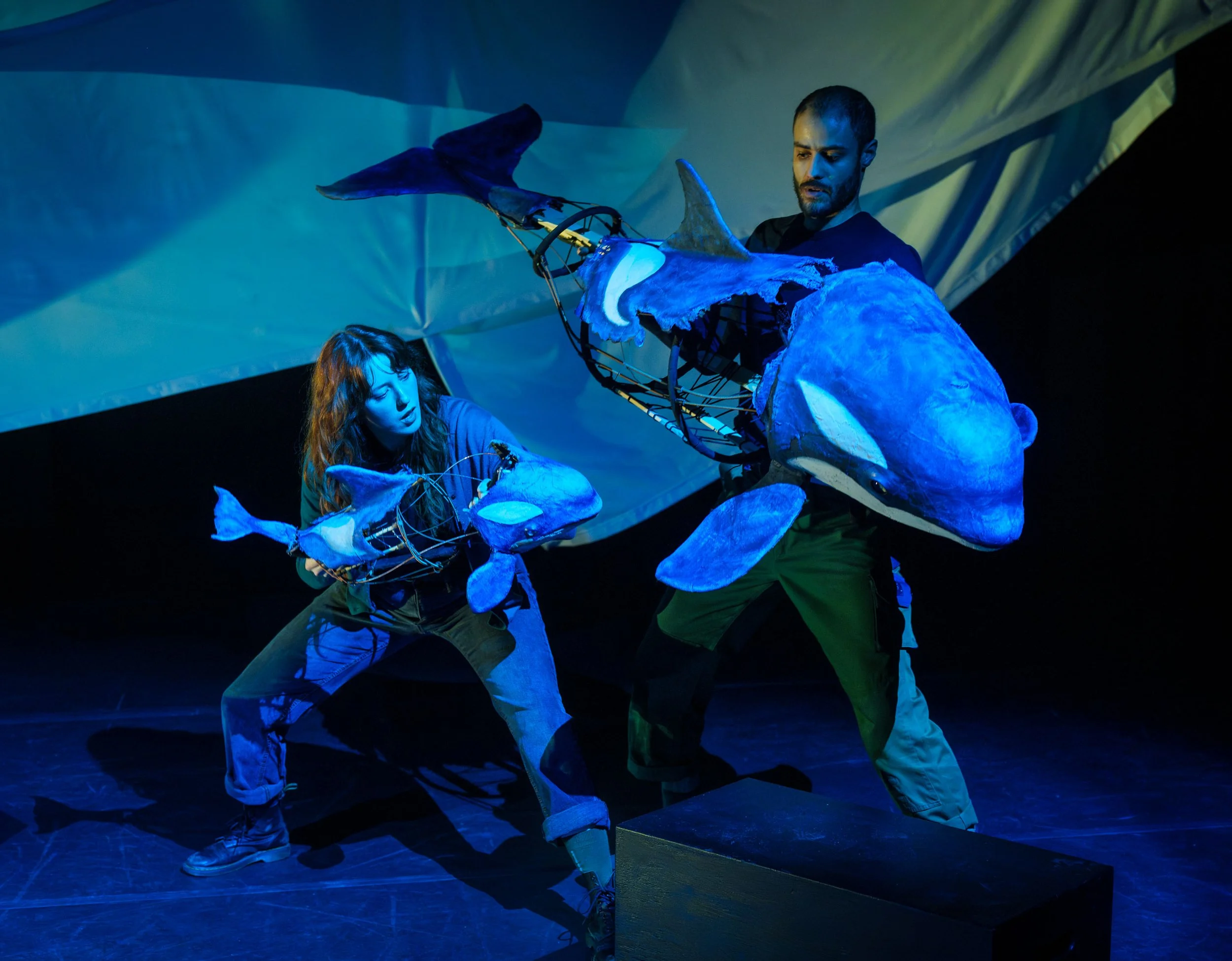
Co-creator and performer Riley Wilson (left) and performer Jeremy Lewis (right).
A mysterious humpback whale was spotted swimming in the normally busy harbour at the Old Port - it was an unexpected sight that captivated Montrealers in the summer of 2020. Mesmerized by the 9.5-meter-long whale’s presence, the sea creature, elegantly breaching and tail-slapping near the Clock Tower, helped bring the community together. Montrealers and tourists alike clung to the hope that the mysterious whale would soon find its way back home, which was somewhere near Tadoussac. The story was a much-needed distraction during a time of confusion and isolation at the height of the pandemic. Years later, recollecting that moment, the idea for Whalefall, an original Infinithéâtre production, emerged for co-creators, Zach Fraser, Ashe Lang and Riley Wilson.
Ashe Lang, co-creator and co-puppet designer, recalled, “It was really just being there and seeing how touched people were who knew nothing about the animals, who were suddenly like: ‘Wow! This is like an incredible creature that we didn't even realize can sometimes be in our backyard.’"
One week later, the young whale managed to redirect her way back home, near Tadoussac. But along the way, she was found floating lifeless in the water, after possibly being struck by a ship. Her carcass was found 30 km northeast of Montreal, and broke the hearts of people all across the country. “The Whalefall storyline starts from the premise of this humpback whale visit, and evolves into something much greater,” Lang explained.
The co-writers reached out to authors, scientists and whale enthusiasts as part of their research to learn more about the sea creature, confirming that the “Montreal Whale” story was just one of so many others that were out there. “When you look into the reality of these animals, it's so much more charming than anything that we could think about them - and the more you learn, the more enchanted you are.” Lang continued.
When a whale dies, its body free-falls from the water’s surface to the bottom of the deep ocean floor. Ninety-eight per cent of marine life exists on or near the oceanbed, even though light only penetrates up to 600 feet from the surface, blocking photosynthesis from occurring anywhere beyond those depths. The aquatic underworld almost fully relies on organic matter coming from up above.
Once the whale reaches the abyss, a new phenomenon unfolds. “A single whale fall can blanket an area of 50 square meters… In that single moment, it delivers a bounty of food equivalent to what small particles would provide over 200 to 2,000 years,” Omnia Saed writes in an Atmos article. Whales become a nutrient-rich source for a variety of marine life for decades after its own physical life has passed, becoming an endless opportunity for health and renewal for the earth’s ocean.
In a prior interview, Zach Fraser, director, co-creator and co-puppet designer, noted, “My mind is blown, often, when I think about the fact that we have these neighbours that live in the St. Lawrence, right beside us, and we know so little about them.” He added, “We might be interested in space travel and understanding aliens from another planet, but there are these massive, majestic beasts that are right next door to us.” These mesmerizing beasts happen to live right alongside humans, just in an entirely different biome.

Performer Jeremy Lewis (left) and co-creator and performer Riley Wilson (right).
Whalefall helps to mend the barrier between land and sea. It takes the audience on a poetic journey of underwater discovery. To highlight the connection between humans and sea animals, the show will incorporate large-scale puppetry, documentary theatre, projections, and original music.
“We didn’t know what to put in the script,” Fraser said. “It’s like, you talk to these professionals who were so eager to talk to us because they’re like, ‘We’re writing these academic papers that nobody actually wants to read.’” They were grateful for the opportunity that the arts world could provide by being a vessel for sharing some of their fascinating oceanic discoveries.
For the show’s writers, there were a polarity of reactions during the interview and research stage. They found themselves in awe with each new finding about the culture and society of whales. “And then,” Riley Wilson, Whalefall co-creator and performer, said, “there’s also the stories that make us reflect on our place in the world, and what damage we do to the planet…”
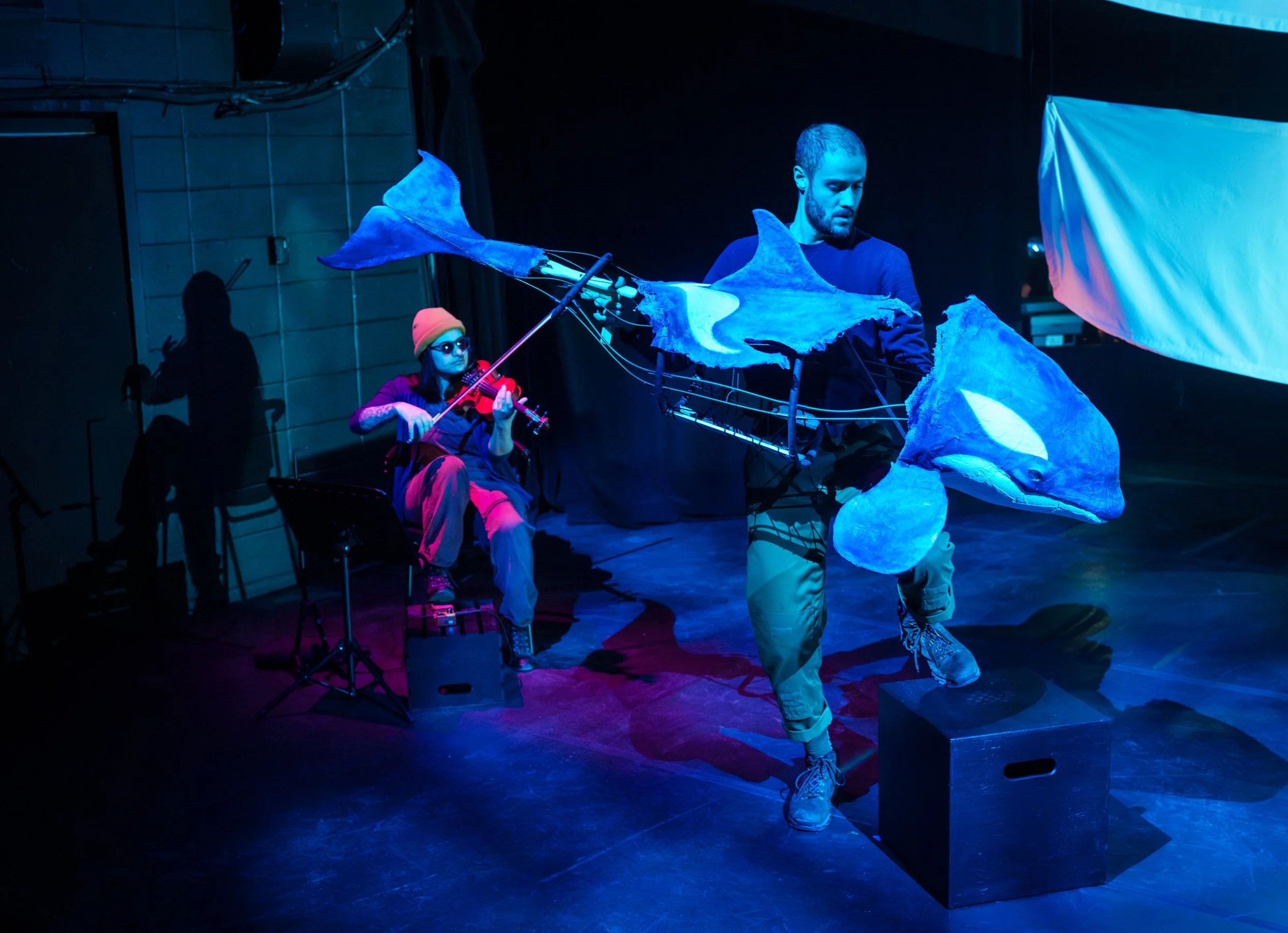
Sound Designer Violette Kay (left) and performer Jeremy Lewis (right).
The creative team’s passion for nature and environmental sustainability is woven into their work. Most of the props used in the play, for example, were either borrowed or found by rummaging through recycling bins. Their goal was to work with objects which had a past life—and they did exactly that. The skeletal base for one of their puppet characters, for instance, was created using piano cable. “We went to piano tuners and piano repair shops and got a bunch of it. It’s very bendable and durable,” Fraser showcased during the interview. Meanwhile, the headpiece for the puppet was inspired by Fraser’s old floor mat. The upcycling possibilities for the team were endless.
Whalefall can be considered a heartfelt love letter to the whale community at large. Fraser said, “During the pandemic, so many things happened.” He added, “We were like, ‘Oh, it’s amazing, all the animals are coming back to the cities, and there’s less air traffic, and people are slowing down.’ In the moment, we learned lessons—let’s not forget those lessons.” A lone whale in the harbour sustains not only the ecosystems below, but also new life above, through theatre. Whalefall is part science, part memory, and part elegy.
The show will run in English, with French subtitles, from February 23rd to March 7 at Théâtre La Chapelle.
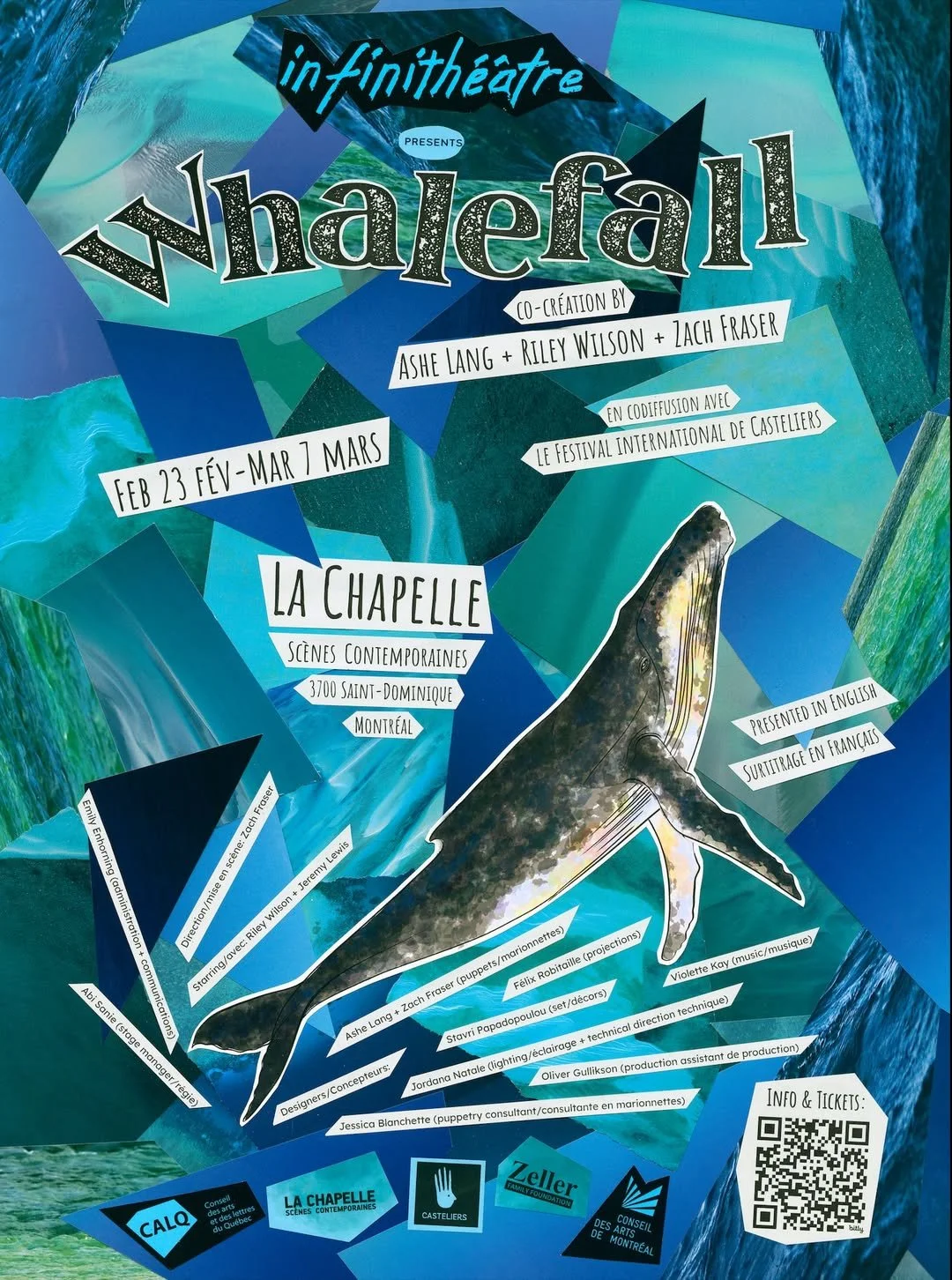
Whalefall
By Infinithéâtre
Running February 23 - March 7, 2026
At La Chapelle Scènes Contemporaines