
“The migrant came to belong”: Behind the Moon at the Rangshala Studio
By Misha Nye
April 8, 2026
“The settler came to colonise, but the migrant came to belong”.
These are the words of Rahul Varma, artistic director of Teesri Duniya Theatre. In this year’s Season of the Migrant, this belonging is explored in all of its beautiful, troubled complexity.
For 45 years now, Teesri has produced politically relevant plays that bring visible minorities from the margins to the centre, creating work with verve, courage, and compassion.
One thing is certain, Teesri’s mandate has always been crystal clear. And when speaking to Rehan Lalani and Chelsea Dab Hilke, sound designer and director on Teesri’s new production, this clarity is evidently a real draw. “Their mission statement is very kept and very solid in how it is acted upon”, Rehan tells me. “You just know where you stand”, Chelsea reiterates. And in the case of Behind the Moon, the season opener, the ground on which you stand is the heart of the matter.
With the Season of the Migrant, Teesri aims “to honour immigrants, humanize their experiences, challenge misinformation, and promote a sense of belonging”. And what better place to start than with the work of Anosh Irani. Continually, in his prose as well as his plays, Irani writes about those on the fringes of mainstream society with dignity and humanity.
Behind the Moon is a tender meditation on belonging and connection. Taking place in a Mughlai restaurant in Toronto, we meet Ayub, a restaurant employee working under the watchful eye of owner Qadir Bhai, and Jalal, a mysterious stranger whose arrival disrupts the peace. At its core, this is “a story of love and loss, freedom and faith, the meaning of brotherhood, and what it means to search for a better life”.
Behind the Moon focuses on three Muslim men from India, all at different stages of being in the country and of being received by the country. Through these different lenses, Irani seeks to present the immigrant experience not as a monolith but as a series of uneven, often conflicting realities shaped by class, circumstance, and personal history.
Anosh Irani’s work typifies the humanising potential of theatre. In a society that continuously dehumanises the very immigrants who prop it up, to render them in their full complexity in this way is not just meaningful, but necessary.
This is especially urgent in the context of rapidly shifting labour regulations. As Rehan illuminates, “the many shifts in labour regulations that Canada is going through, with migrant temporary workers at the forefront, in turn generate a lot of South Asian hate”. Measures such as Bill C-12, which allows the government to erase visa applications without explanation, intensify this. Behind the Moon humanises those caught within these systems, foregrounding urgent questions of status and dignity.
What is particularly refreshing, Chelsea points out, is the lack of a white gaze. Even when handled sensitively, the presence of a white character can pull the energy and focus in another direction. Here, by rendering that figure an unseen “other”, we allow those onstage to breathe, to unfold on their own terms.
When you take away distractions like this, you reveal the bare bones of who Ayub, Jalal, and Qadir Bhai really are: three men grappling with deeply familiar feelings–homesickness, dislocation, and loneliness.
Maybe this is what all great plays create. That alchemy of specificity and universality. That mixture of sharp, political comment and tender, emotional resonance. And when it works, as Behind the Moon so clearly does, its influence is as wide as it is deep.
For instance, Rehan tells me, “I am a Muslim Indian from Mumbai who worked in kitchens for a long time”. The sardonic South Asian wit, the late-night pressure cooker of a restaurant, Rehan felt immediately seen by Irani’s work. For Chelsea, however, it was the tenderness of the script that caught her eye: “I was interested in the characters’ experience of loneliness and in seeing three men onstage navigating their emotional journeys together. I like to see men being vulnerable–supporting one another, lifting each other up, helping each other through difficult moments”.
In an interview, Anosh Irani gave a fascinating insight into his process: “If characters refuse to leave me, I just follow them. And listen”. Behind the Moon, a show that brims with such specificity and warmth, is testament to this listening. Ayub, Jalal, and Qadir Bhai have led Irani this far, and now it’s our turn to meet them.
Behind the Moon runs from April 3 to 19 at Teesri Duniya Theatre’s Rangshala. When I asked about the full-length run ahead of them, Rehan and Chelsea smiled. All artists want their work to get the airtime it deserves, and when facing perennial challenges of space and funding, Teesri’s commitment to giving performances the space to breathe, evolve, and deepen is especially welcome.
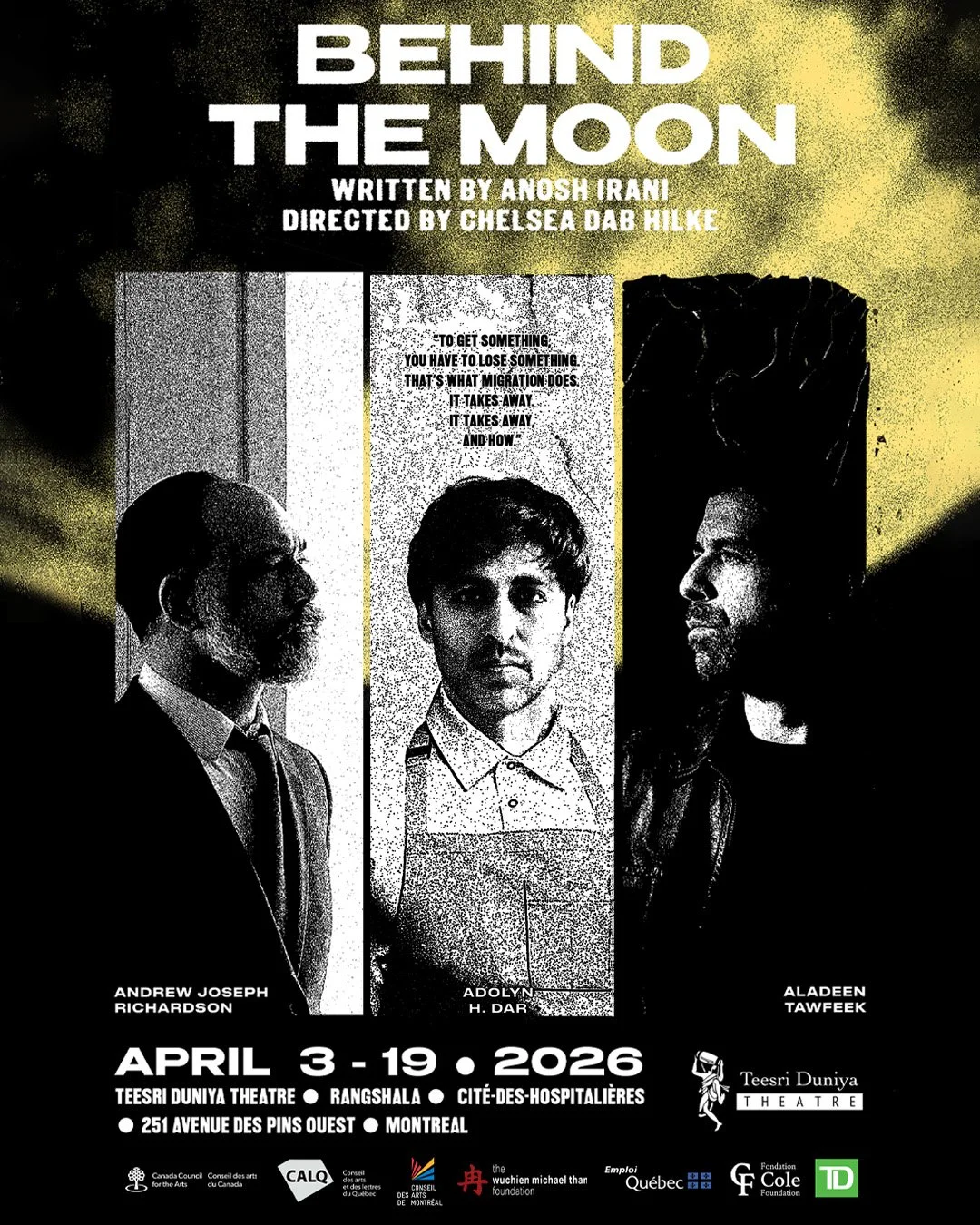
Behind the Moon
Teesri Duniya Theatre
Running April 3-19, 2026
At Rangshala, Teesri Duniya Theatre